
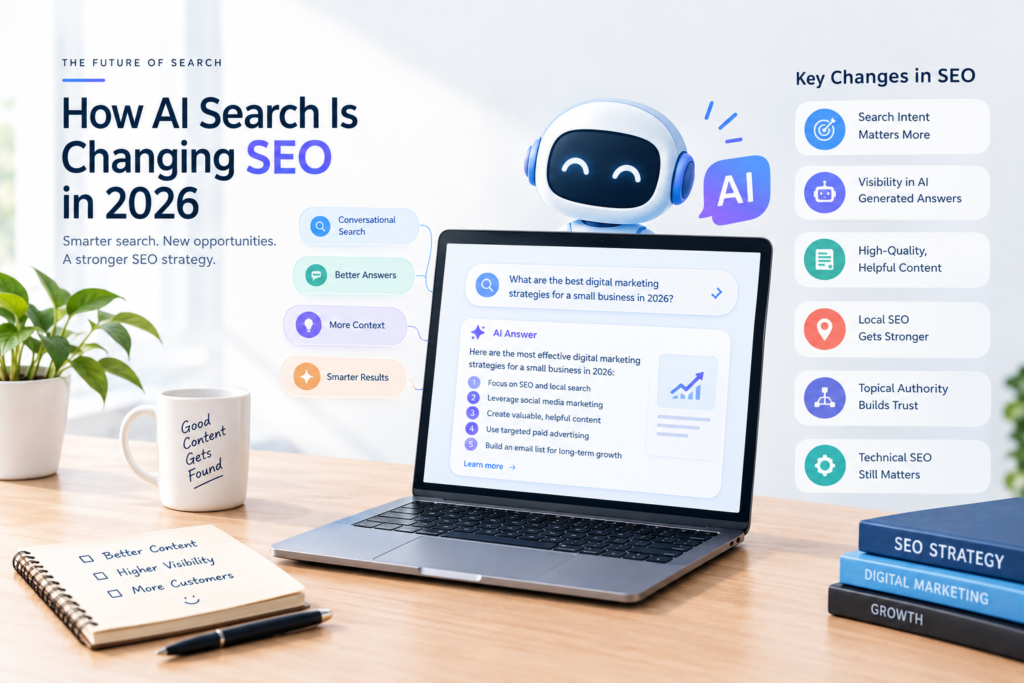
Search engines are changing faster than ever. For years, businesses focused on ranking on the first page of Google to attract visitors, generate leads, and grow their online presence. But in 2026, the way people search for information is becoming more conversational and AI-driven.
People are no longer relying only on traditional search results. They are asking AI-powered search platforms detailed questions and expecting direct, useful answers. This shift is changing how websites need to approach SEO.
For businesses and marketers, understanding how AI search is changing SEO in 2026 is becoming essential for staying visible online.
What Is AI Search?
AI search uses artificial intelligence to understand the meaning and context behind a user’s query. Instead of simply matching keywords with webpages, AI-powered search systems can interpret questions, combine information from different sources, and provide summarized answers.
For example, instead of searching for:
“best digital marketing strategies 2026”
a user might ask:
“What digital marketing strategy should a small business use in 2026 to attract local customers with a limited budget?”
AI search can understand the intent behind this question and provide a more detailed response.
This means SEO is moving beyond simply targeting keywords. Content now needs to answer real questions and provide genuine value.
1. Search Intent Is Becoming More Important
Traditional SEO has always considered search intent, but AI search makes it even more important.
Search engines are becoming better at understanding what users actually want. A page that repeatedly uses a keyword but does not provide a useful answer may struggle to gain visibility.
For example, if someone searches for “local SEO tips,” they may want practical steps, examples, tools, or strategies—not a general definition of local SEO.
In 2026, marketers should create content around the purpose behind a search, rather than focusing only on keyword frequency.
Before creating content, ask:
- What problem is the user trying to solve?
- What information are they looking for?
- What questions might they ask next?
- Can my content provide a complete and useful answer?
2. SEO Is Moving Beyond Traditional Google Rankings
For many years, SEO success was measured primarily through keyword rankings and organic traffic.
AI search is creating another important goal: getting your content recognized and referenced as a useful source in AI-generated answers.
This doesn’t mean traditional SEO is disappearing. Search engines still rely on websites, webpages, structured information, and other signals to understand and retrieve information.
However, marketers increasingly need to think about visibility across different search experiences, not just a traditional list of blue links.
This is why concepts such as Answer Engine Optimization (AEO) and Generative Engine Optimization (GEO) are becoming more relevant.
3. High-Quality Content Matters More Than Ever
AI can generate content quickly, but producing large amounts of text does not automatically make a website valuable.
In fact, when users can get basic information from AI-generated answers instantly, websites need to offer something more useful.
Good content should be:
- Original
- Accurate
- Helpful
- Easy to understand
- Well researched
- Relevant to the audience
- Supported by experience or credible information
Instead of writing a 1,000-word article simply to target a keyword, marketers should focus on answering the reader’s questions as clearly as possible.
Human experience, examples, opinions based on expertise, original research, and practical insights can make content more valuable.
4. Conversational Search Is Growing
AI search encourages people to search in a conversational way.
Instead of entering short phrases, users can ask complete questions.
For example:
“How can I improve my website’s SEO if I don’t have a large marketing budget?”
This creates opportunities for businesses to target long-tail and question-based searches.
Content can include sections such as:
- What is SEO?
- Why is SEO important?
- How can small businesses improve SEO?
- How much does SEO cost?
- What are the easiest SEO improvements to make?
Answering related questions helps create comprehensive content that matches different stages of the user’s search journey.
5. Topical Authority Is Becoming Important
AI search needs to understand which sources provide useful information about a particular subject.
This makes topical authority increasingly important.
Instead of publishing one article about SEO and moving to an unrelated topic, businesses can build a collection of useful content around a specific subject.
For example, a digital marketing website could create content about:
- SEO
- Local SEO
- Technical SEO
- Content marketing
- Social media marketing
- Google Business Profile
- AI search
- Digital advertising
These related articles can be connected through internal links, helping users and search engines understand the website’s expertise.
6. Local SEO Is Also Changing
AI search is particularly relevant to local businesses.
People may ask AI-powered platforms questions such as:
“Who is a good digital marketing professional near me?”
or:
“What digital marketing services are available for small businesses in Trivandrum?”
For local businesses, maintaining accurate business information and creating useful local content remains important.
A strong local SEO strategy can include an optimized website, relevant local content, accurate business information, customer reviews, and a well-maintained Google Business Profile.
For someone looking for a Digital Marketing Strategist in Trivandrum, for example, useful location-specific content can help demonstrate expertise while also connecting the business with relevant local searches.
7. Technical SEO Still Matters
AI search does not mean technical SEO is no longer important.
Search engines still need to discover, crawl, understand, and access website content.
Marketers should continue paying attention to:
- Website speed
- Mobile usability
- Internal linking
- Proper headings
- Structured data
- Indexability
- Secure HTTPS connections
- Clear website architecture
A website can have excellent content, but technical problems can make it difficult for search engines and users to access that content.
8. The Future of SEO Is About Being Useful
The biggest change AI search brings to SEO is a shift in mindset.
SEO should not simply be about trying to manipulate rankings. It should be about becoming a useful source of information.
Businesses that understand their audience, answer real questions, demonstrate expertise, and consistently publish valuable content can build stronger online visibility.
AI search may change how information is presented, but the need for trustworthy and useful information remains.
Conclusion
AI search is changing SEO in 2026 by making search more conversational, contextual, and focused on answering users’ questions.
Traditional SEO still matters, but marketers need to think beyond keywords and rankings. Search intent, high-quality content, topical authority, technical SEO, local relevance, and genuine expertise are becoming increasingly important.
For businesses, this is an opportunity rather than simply a challenge. Instead of creating content only for search engines, brands can focus on creating content that genuinely helps people.
The future of SEO belongs to businesses that can adapt to changing search behavior while continuing to provide accurate, useful, and human-focused information.